
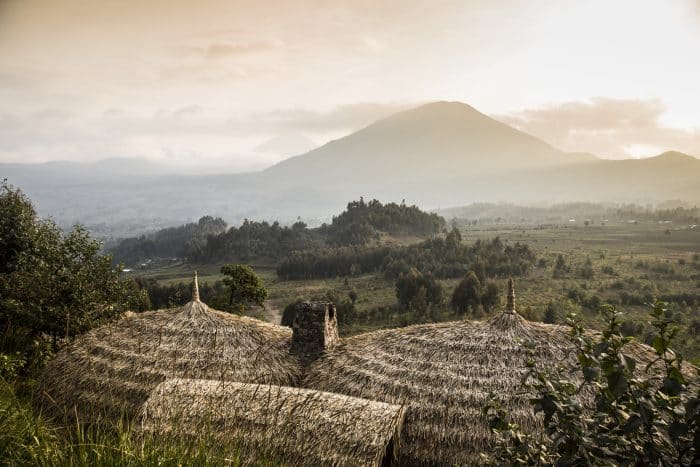
Bisate, Gorilla's Nest and Kwitonda sit at the top of the Volcanoes National Park accommodation market, each built around individually spaced cottages with volcano views and a short drive to the park headquarters. They differ mainly in setting, scale and architectural style rather than in the core trekking logistics, since all three serve the same gorilla trekking briefing point.
Table of Contents
- Why these three sit above the rest of the market
- Setting and architecture
- Distance to the trekking briefing point
- Scale and privacy
- Food, service and inclusions
- Reforestation and community involvement
- Booking timing at this tier
- How this tier fits a wider Rwanda itinerary
- How each lodge treats the gorilla trek itself
- Deciding based on your wider Rwanda route
- What first-time visitors sometimes get wrong
- A short list of what actually differs between the three
- Frequently Asked Questions
Why these three sit above the rest of the market
Volcanoes National Park has a wide accommodation market, from budget guesthouses in Musanze to a broad mid-range tier covered in our guide to mid-range lodges near Volcanoes National Park. Above all of that sits a small handful of lodges recognised internationally for their design, service and setting, of which Bisate, Gorilla's Nest and Kwitonda are the three most frequently compared by travellers planning a high-end gorilla trekking trip.
Each charges well above the regional average, and each books out early for the peak trekking months, so this comparison assumes you have already decided this tier fits your budget and are choosing between the three rather than deciding whether to spend at this level at all. If you are still deciding on that broader question, our hotel and lodge booking service can talk through the trade-offs against the mid-range tier for your specific dates.
Setting and architecture
Bisate is built into the bowl of an eroded volcanic cone, with a small number of thatched, cocoon-shaped cottages set into the reforested slope facing Bisoke and Karisimbi. Its setting is one of the most distinctive in the region, with the surrounding hillside itself part of an active reforestation project.
Gorilla's Nest sits closer to the park headquarters itself, with a more traditional lodge layout and gardens, and has long been one of the most established properties in the area, predating some of the newer arrivals in this tier.
Kwitonda is a newer entrant, built with a design emphasis on space and privacy between cottages, and sits within its own grounds near the park boundary with views toward the volcanic range.
| Lodge | Setting | Distinctive feature |
|---|---|---|
| Bisate | Reforested volcanic bowl | Cocoon-shaped cottages, active reforestation project |
| Gorilla's Nest | Near the park headquarters | Established, traditional lodge layout |
| Kwitonda | Park boundary grounds | Newer build, spaced-out cottage design |
Distance to the trekking briefing point
All three lodges sit within a short drive of the park headquarters near Kinigi, and none of them meaningfully disadvantages you on trekking morning compared with the others. Gorilla's Nest, given its position closest to the headquarters itself, typically offers the shortest transfer of the three, though the difference across all three lodges is measured in minutes rather than anything that should decide your choice on its own.
At this price tier, choose based on setting, architectural style and the specific room category, rather than on the small differences in drive time to the briefing point, since all three are well positioned for an early trekking start.
Scale and privacy
Each of these lodges operates with a deliberately small number of rooms compared with a conventional hotel, which is part of what allows a high staff-to-guest ratio and a quieter, more private atmosphere. If privacy and space between cottages matter most to you, ask each property directly how far apart individual units sit and how sound travels between them, since this varies even within this small group of high-end lodges.
Food, service and inclusions
At this level, meals are typically included in the nightly rate as full board, often alongside guided nature walks, cultural visits to nearby communities, or other activities beyond the gorilla trek itself. Ask specifically what is included in the rate you are quoted, since some inclusions are standard across the tier while others are offered as optional extras depending on the lodge and season.
Reforestation and community involvement
Several lodges in this tier, Bisate in particular, are known for restoring native forest on land that was previously farmland, both to extend habitat at the park's edge and to change the relationship between the park boundary and surrounding communities. This kind of programme is worth asking about directly if it matters to your choice, since the scale and nature of these projects differ between properties and change over time.
Volcanoes National Park's boundary has, over recent years, been the subject of several reforestation and land-use initiatives involving both the park authority and individual lodges, though the specifics of any single project are worth confirming directly with the property rather than assuming.
Booking timing at this tier
Rooms across all three lodges are limited, and the peak trekking season books out well ahead of typical hotel timelines, sometimes many months in advance for the most sought-after room categories. If your trip dates are fixed around a specific gorilla trekking permit, treat lodge booking as an equally time-sensitive step, not something to finalise after the permit is secured.
How this tier fits a wider Rwanda itinerary
Most travellers booking at this level are combining a Volcanoes National Park stay with other parts of Rwanda, commonly Kigali at the start or end of the trip and sometimes a Lake Kivu stay for contrast. Our guide to where to stay near Volcanoes National Park sets out how this leg fits against the wider mid-range and budget market in the same area, useful context even if you have settled on this luxury tier, since it explains what your money is buying relative to the rest of the market. For your onward trekking plans, our gorilla trekking page covers what the day itself involves.
How each lodge treats the gorilla trek itself
The trek is organised by the park authority rather than by any individual lodge, so the gorilla group you are assigned, the difficulty of that day's terrain and the length of the hike are the same regardless of which of these three lodges you choose. What differs is the support around it: how the lodge prepares your packed breakfast, whether a hot towel and refreshment are waiting on your return, and how the afternoon after a demanding trek is handled. These details are where the higher staff ratios at this tier become noticeable in a way that a standard mid-range lodge, covered in our guide to mid-range lodges near Volcanoes National Park, typically cannot match.
Deciding based on your wider Rwanda route
If your trip also includes Lake Kivu, our guide to where to stay around Lake Kivu is worth reading alongside this comparison, since some travellers choose a slightly shorter stay at this luxury tier in order to extend time at the lake, while others prioritise the volcanoes leg and treat Lake Kivu as a shorter add-on. Neither approach is wrong, but deciding early avoids reshuffling non-refundable bookings later.
What first-time visitors sometimes get wrong
A common assumption is that a higher nightly rate at this tier buys a better gorilla trek, when in fact the trek itself, the specific gorilla family assigned and the terrain that day are decided by the park authority and are identical regardless of where you sleep. What the higher rate buys is a more comfortable and better supported experience around the trek, not a different trek. Setting this expectation correctly before you book avoids disappointment if your allocated trek turns out to be more physically demanding than a neighbouring group's, which can happen at any accommodation tier.
A short list of what actually differs between the three
- Setting: a volcanic bowl at Bisate, proximity to the headquarters at Gorilla's Nest, and boundary grounds at Kwitonda
- Architectural style: distinctive cocoon-shaped cottages versus more traditional or contemporary layouts
- History: an established, longer-running property versus newer arrivals in this tier
- Reforestation and community programmes, which vary in scale and are worth confirming directly
Frequently Asked Questions
Is one of Bisate, Gorilla's Nest or Kwitonda clearly the best choice?
No single one suits every traveller. The choice usually comes down to architectural style and setting preference, since all three offer comparably high service standards and similarly short transfers to the trekking briefing point.
Which of the three is closest to the park headquarters?
Gorilla's Nest typically sits closest, given its position near the headquarters itself, though the difference across all three lodges is a matter of minutes rather than a significant logistical factor.
Do these lodges include meals in the room rate?
Meals are typically included as full board at this tier, though specific inclusions vary by lodge and by rate plan, so confirm exactly what is covered when you book.
How far in advance should I book at this level?
Well in advance, often many months ahead for the peak trekking season, since room counts at each property are deliberately small and demand is highest during the drier months.
Are these lodges involved in forest conservation?
Several properties in this tier, Bisate in particular, are associated with reforestation and community land-use projects near the park boundary. Confirm the current scope of any specific programme directly with the lodge.
Is this tier worth it compared with the mid-range lodges nearby?
It depends on your priorities. The core trekking experience, the park itself and the gorillas, is the same regardless of where you stay, so this tier is worth it mainly if architectural setting, space and a higher staff ratio matter to your trip.