
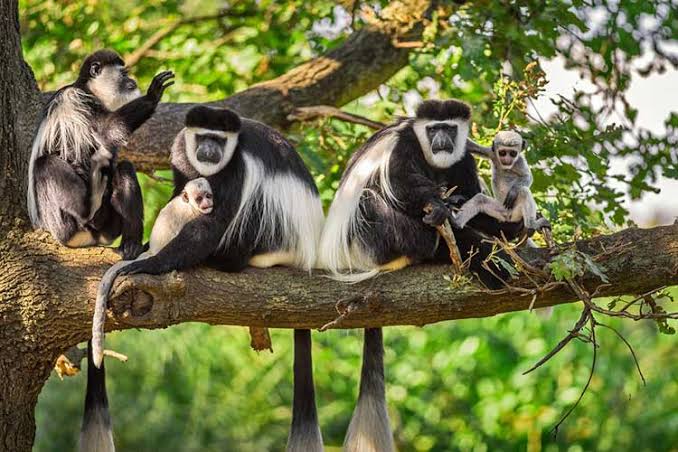
Nyungwe hosts 13 primate species, more than any other single park in East Africa, headlined by chimpanzees and colobus troops several hundred strong, alongside less commonly seen species like L'Hoest's monkey, the owl-faced monkey, red-tailed monkey and olive baboon. Most visitors realistically see a handful of species across a multi-day stay rather than the full list in one visit.
Table of Contents
- 1. Chimpanzees
- 2. Black-and-White Colobus
- 3. L'Hoest's Monkey
- 4. Owl-Faced Monkey
- 5. Red-Tailed Monkey
- 6-7. Blue Monkey and Silver Monkey
- 8-9. Grey-Cheeked Mangabey and Olive Baboon
- 10-13. Vervet Monkey and the Remaining Species
- Why Nyungwe Hosts So Many Primate Species
- A Common Mix-Up Worth Clarifying
- Frequently Asked Questions
1. Chimpanzees
Nyungwe's flagship primate, tracked on dedicated permit-based treks each morning. See our chimpanzee trekking complete guide for the full trekking process, cost and what to expect on the day itself.
2. Black-and-White Colobus
Nyungwe is home to one of Africa's largest colobus troops, with groups reported in the hundreds moving together through the canopy, a striking sight when a troop this size is on the move. See our colobus monkey trekking guide for how to arrange a dedicated viewing.
"A striking sight when a troop this size is on the move."
3. L'Hoest's Monkey
A distinctive forest-floor-favouring species with a notably long tail and expressive face, less commonly seen than chimpanzees or colobus but a highlight when spotted. L'Hoest's monkey tends to stay lower in the forest structure than many of Nyungwe's other primates, making ground-level attentiveness worthwhile on any trail.
4. Owl-Faced Monkey
One of Nyungwe's most visually striking and least commonly seen primates, named for its distinctive facial markings. See our Nyungwe primates deep-dive guide for more on this and other standout species covered in fuller detail there.
5. Red-Tailed Monkey
Named for its distinctive coppery tail, this smaller guenon species is relatively active and vocal, often heard moving through the canopy before it's spotted visually. It's also a quick mover, tending to travel in loose groups through mid-canopy branches, which means patient, still observation from a good vantage point often produces better results than actively trying to track it on foot.
6-7. Blue Monkey and Silver Monkey
Both mid-sized guenon species present in Nyungwe's forest, generally encountered in the canopy rather than at ground level. Exact current taxonomic classification and regional naming for these species can vary by source; ask your guide for the specific terminology used locally.
8-9. Grey-Cheeked Mangabey and Olive Baboon
The grey-cheeked mangabey favours mid-to-upper canopy levels and has a distinctive, far-carrying call that often signals its presence before a sighting; listening for that call is often more productive than scanning the canopy visually. Olive baboons, more commonly associated with savanna habitats elsewhere in Africa, are also present in Nyungwe's forest-edge zones, typically encountered in larger, more visible troops than the forest's more secretive canopy-dwelling species.
10-13. Vervet Monkey and the Remaining Species
Vervet monkeys round out the more commonly encountered species, particularly near forest edges and cleared areas, recognisable by their pale grey coats and dark faces. The complete, current list of all 13 recognised species, including less-documented and nocturnal species such as galagos (bushbabies), is best confirmed directly with park authorities or your guide, since primate taxonomy and regional species counts are periodically revised by researchers as field surveys continue.
Why Nyungwe Hosts So Many Primate Species
Nyungwe's primate diversity comes down largely to the forest's age, scale and intact canopy structure. As one of Africa's oldest surviving montane rainforests, protecting roughly 1,000 square kilometres of continuous habitat, Nyungwe offers the kind of undisturbed, layered forest environment that supports a wide range of primate niches: ground-dwelling, mid-canopy and upper-canopy species can all coexist without the habitat fragmentation that limits diversity in smaller or more disturbed forest patches elsewhere in the region.
This matters practically for visitors too: because different species occupy different layers of the forest, a single hike can realistically expose you to species with very different habits within the same few hours, from ground-foraging L'Hoest's monkeys to canopy-dwelling colobus troops moving overhead.
A Common Mix-Up Worth Clarifying
Golden monkeys, a popular trekking draw in Rwanda, are specific to the bamboo zones of Volcanoes National Park, not Nyungwe. This is a common point of confusion for first-time visitors researching Rwanda's primates, so it's worth clarifying clearly before you plan an itinerary around seeing them in the wrong park. See our golden monkey trekking guide for that separate experience.
Frequently Asked Questions
Are golden monkeys found in Nyungwe National Park?
No. Golden monkeys are specific to the bamboo zones of Volcanoes National Park, not Nyungwe. Confusing the two is a common mistake worth avoiding when planning.
Which Nyungwe primate is easiest to see?
Chimpanzees and the large colobus troops are the most reliably sighted on organised treks, since both are actively tracked and habituated to guided visits.
Can I see all 13 primate species on one visit?
No. Realistically, most visitors see a handful of species across a multi-day stay; seeing all 13 would require exceptional luck or a very extended, dedicated primate-focused visit.
Is L'Hoest's monkey commonly seen in Nyungwe?
It's present but less commonly encountered than chimpanzees or colobus troops, making sightings a highlight for travellers who spot one.
Do I need separate permits for different primate species?
Chimpanzee trekking requires its own permit; most other primate sightings happen incidentally on standard hiking trails rather than through species-specific permits.
What's the best way to see the most primate diversity in one trip?
Combining a dedicated chimpanzee trek with general forest hiking trails and a guided colobus walk gives the broadest realistic chance of diverse sightings within a standard multi-day visit.
Why does Nyungwe have more primate species than other parks?
The forest's age, scale and undisturbed canopy structure support a wide range of primate niches: ground-dwelling, mid-canopy and upper-canopy species can coexist here in a way smaller or more fragmented forests can't sustain.