
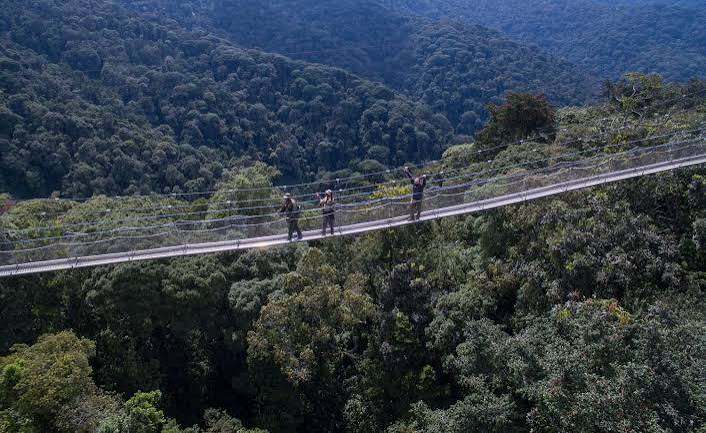
Nyungwe National Park has more than a dozen marked trails, ranging from a one-hour walk to the canopy walkway to a full-day climb of Mount Bigugu. The right choice depends on your fitness, the time you have, and whether you want waterfalls, birds or a summit view. Most visitors combine one short trail with one longer one across a two-day stay.
Table of Contents
- Why Nyungwe's trails differ so much
- The trails at a glance
- Canopy Walkway: the easiest introduction
- Isumo Waterfall Trail: the classic half-day walk
- Bigugu Trail: the serious option
- Kamiranzovu Trail: wetland and orchids
- Trails built around wildlife rather than distance
- Matching a trail to your time in the park
- Night walks: a different kind of trail
- Getting to the trailheads
- Trail markers and staying oriented
- What footwear actually makes a difference
- Combining trails with a Kigali-based itinerary
- Mistakes to avoid
- Frequently Asked Questions
Why Nyungwe's trails differ so much
Nyungwe National Park covers a large block of montane rainforest, and its trail network was built to reach different features rather than to offer one standard walk. Some trails aim at a single waterfall, some follow ridgelines for views, and one, the canopy walkway, is a fixed structure rather than a hiking route. Before booking anything, it helps to decide what you actually want to see, since a trail chosen for wildlife looks nothing like one chosen for a summit. Start with our Nyungwe National Park guide if you have not yet settled on which days to spend here.
The trails at a glance
| Trail | Typical duration | Difficulty | Main draw |
|---|---|---|---|
| Canopy Walkway loop | 2 to 3 hours | Easy to moderate | Suspension bridge above the canopy |
| Isumo Waterfall Trail | 3 to 4 hours | Moderate | Waterfall, stream crossings |
| Igishigishigi Trail | 1.5 to 2 hours | Easy | Short forest loop, good for a first walk |
| Bigugu Trail | Full day | Strenuous | Park's highest point, wide views |
| Kamiranzovu Trail | 3 to 4 hours | Moderate | Swamp wetland, orchids, birds |
| Ngabwe or short primate trails | Half day, variable | Moderate | Chimpanzee or colobus tracking, timing depends on the group |
Canopy Walkway: the easiest introduction
The canopy walkway is Nyungwe's best known feature, a suspended walkway strung between towers that puts you above the forest canopy rather than under it. The approach walk is moderate rather than difficult, and the walkway itself is short, so the whole outing suits visitors with limited time or mixed fitness levels in the group. It works well as a first activity on arrival, since it needs no early start and gives a clear sense of the forest's scale before a longer trail the next day.
Arrive early if you want fewer people on the walkway itself. It is Nyungwe's most visited feature and can have a queue by mid-morning in peak season.
Isumo Waterfall Trail: the classic half-day walk
The trail to Isumo Waterfall follows a stream through dense forest before reaching a waterfall that drops into a pool below a rock face. It involves some uneven footing and a few stream crossings, so it sits in the moderate category rather than easy, but it needs no technical skill. Our detailed route notes in the Isumo Waterfall Trail guide cover the crossings and the best time of day for photographs.
Bigugu Trail: the serious option
Mount Bigugu is the highest point in Nyungwe, and the trail to its summit is a full day out, with a sustained climb through changing vegetation zones. This is the trail to choose if you want a genuine hike rather than a nature walk, and it rewards fitness with wide views over the forest canopy and, on a clear day, distant ridgelines. Start early, since the round trip takes most of a day and afternoon cloud can close in on the summit.
Bigugu's summit sits well above the forest floor's average elevation, which is why the vegetation changes noticeably as you climb, from dense lower forest to more open highland growth near the top.
Kamiranzovu Trail: wetland and orchids
This trail leads to Nyungwe's swamp wetland, a flat, open area within the forest that supports plant life not found on the drier trails, including several orchid species. It is a good choice for birders and for anyone who wants a change from dense canopy walking, since the wetland opens the sky in a way most of the park does not. Bring insect repellent, since standing water attracts more mosquitoes here than elsewhere in the park.
Trails built around wildlife rather than distance
Several of Nyungwe's most rewarding walks are not measured by distance at all, but by where the wildlife is that morning. Tracking Nyungwe's colobus monkeys or joining a search for one of the park's other primates means following guides and trackers rather than a fixed loop, and the walk can run short or long depending on how quickly the group is found. Budget a flexible half day for these rather than planning around a set trail length.
Matching a trail to your time in the park
- One day in Nyungwe: pair the Canopy Walkway with either Igishigishigi or a short stretch of the Isumo trail.
- Two days: add either Bigugu or a full primate tracking morning, since both need most of a day on their own.
- Interested mainly in birds and plants: prioritize Kamiranzovu over Bigugu, since the wetland's flat terrain suits slower, observation-focused walking.
Guides are required on all of Nyungwe's trails. This is a safety and conservation rule, not an optional add-on, and it also means you get identification of birds, plants and animal signs you would otherwise miss.
Night walks: a different kind of trail
Not every trail in Nyungwe is walked in daylight. A guided Nyungwe night walk covers some of the same ground as the daytime trails but reveals a different set of animals, from chameleons to nocturnal primates, and runs on a shorter, slower route with spotlights. It suits visitors who have already done a longer day hike and want a lighter second activity.
Getting to the trailheads
Most trailheads are reached from the park's reception areas, and driving time between them can be significant, since Nyungwe is large. If you are arriving from Kigali, our guide on getting to Nyungwe sets out the drive and where to base yourself so the trailhead you want is not an hour away each morning. Booking your chosen tour through chimpanzee trekking in Nyungwe also gives you a guide who can advise on trail conditions on the day.
Trail markers and staying oriented
Nyungwe's trails are marked at intervals, but the dense canopy on several routes can make it easy to lose your sense of direction if you wander off the path, which is another reason a guide is not optional here. On longer trails such as Bigugu, weather can change the character of a familiar section within an hour, with mist reducing visibility on ridgelines that were clear at the start of the day. Trust your guide's pacing and route decisions, since they are trained to read both the weather and the terrain in ways a first-time visitor cannot.
What footwear actually makes a difference
Hiking boots with ankle support are worth the extra weight in your luggage for Nyungwe, particularly on Bigugu or Isumo, where roots, loose rock and mud can all appear on the same short stretch of trail. Trail runners work adequately on the shorter, easier routes such as Igishigishigi or the Canopy Walkway approach, but they offer less protection on the steeper, longer hikes. Whatever you choose, break footwear in before your trip rather than wearing it for the first time on a Bigugu ascent, since new boots on a full-day hike are a common and avoidable source of blisters.
Combining trails with a Kigali-based itinerary
Most visitors reach Nyungwe as part of a wider Rwanda trip rather than a standalone visit, and trail choice should factor into how much time you have allocated overall. If your Rwanda itinerary is tight, prioritize one or two trails rather than attempting the full network, and read our guide on getting to Nyungwe from Kigali to understand how much of your schedule the journey itself will consume before you even reach a trailhead.
Mistakes to avoid
Do not choose Bigugu on a day when you also want to fit in a second activity, since the full-day climb leaves no room for anything else. Do not underestimate the Isumo trail's stream crossings in wet weather, when rocks become slick. And do not skip proper footwear for what looks like a short walk, since Nyungwe's paths are rarely flat or dry for long.
Frequently Asked Questions
Which Nyungwe trail is best for a first-time visitor?
The Canopy Walkway loop is the easiest introduction, since it needs no early start and gives a clear sense of the forest before committing to a longer trail the next day.
How difficult is the Bigugu Trail?
It is Nyungwe's most strenuous hike, a full day with a sustained climb to the park's highest point. It suits fit hikers who want wide views rather than a relaxed nature walk.
Do I need a guide for every trail in Nyungwe?
Yes. Guides are required on all trails, both for safety and to protect the forest, and they also identify wildlife and plants you would likely miss on your own.
Can I combine two trails in one day?
Short trails such as the Canopy Walkway and Igishigishigi can be combined, but longer routes such as Bigugu or a primate tracking morning typically fill the whole day on their own.
Are Nyungwe's trails suitable for children?
The shorter, flatter trails such as Igishigishigi work well for older children with reasonable fitness. Longer routes like Bigugu are better suited to adults and teenagers used to hiking.
What should I pack for a Nyungwe hike?
Closed, sturdy shoes, a rain layer even in dry season, insect repellent, and water. Trails can be muddy and weather changes quickly at this altitude.